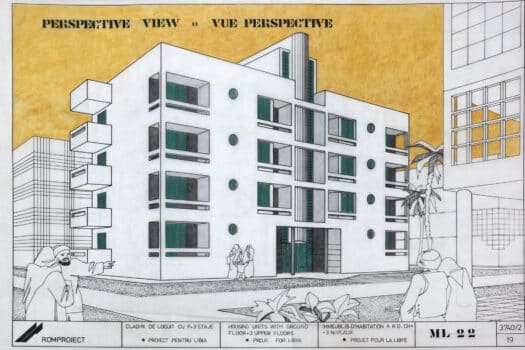
Universalism may have been a central tenet of modernism; but its tropical variant diverged from this principle — it responded to particular local conditions. Although the common denominator was concrete — ubiquitous in modernist structures around the world — buildings such as the U.S. Embassy in Accra, by Harry Weese, used wood as both an aesthetic response to regional cultural sensibilities and as a pragmatic means of fostering air circulation. The local climate (which can vary from humid and rainy to dry and hot) drove site strategies that harnessed shade and breezes. Innovative screen walls and brise-soleils, along with rooftop verandahs and deep overhangs, some adapted from indigenous building types, were incorporated to alleviate the heat and correspond to local aesthetics. And today, although the concrete walls, columns and screens are crumbling in places, most of the buildings we visited still served their original purpose. Students occupied classrooms. Original owners lived in their homes. To be sure, many of the structures had been modified and adapted. Pitched roofs were added to adequately shed water from heavy rains. Air conditioning — signaling both social status and the assumption of abundant cheap energy — now provides relief in ways that screen walls and louvered windows could not. In such cases Tropical Modernism had been outpaced by Western, especially American, notions of comfort and consumption.
During our travels we began to see these buildings as situated within a constellation of historical and contemporary forces. The hulking slave forts of
Elmina and
Cape Coast, for example, once stood as sentinels, guarding the thresholds of the country, where raw materials and human cargo left Ghanaian shores on ships bound for the New World and Europe. Along with Swedish, Portuguese and Dutch traders, the British exploited this lucrative network; and it was the British colonial enterprise that incubated Tropical Modernism in what was then known as the Gold Coast. The proposed new cities and the actual built works, particularly the many schools constructed under British stewardship, were part of an ongoing social project intended to cultivate "proper" colonial subjects. By the time of the first successful independence movement in Africa, led by Kwame Nkrumah, founder of the Organization of African Unity and the first president of Ghana, the British Empire’s vast reach in Africa had begun to recede; and with the establishment of Ghana, in 1957, government officials and private citizens enlisted these same architects to build the national museum, the office buildings, private homes, embassies, and university buildings of the new country. Adapting the climate-responsive ethos of Tropical Modernism to the needs of the nation state, Nkrumah remarked, in an early speech, “We can ... develop the use of one source of energy which we have in abundance — the heat of the sun. Already in Accra and in other towns, architectural designs have been evolved which make use of the sun to produce draughts of air, which, by flowing over the surface of the roof and walls of the building, keep it cool.” Tropical Modernism satisfied the managerial needs of the new state.
Yet despite the Tropical Modernist promise of a better world, the rich and poor of Ghana have continued to occupy separate worlds — worlds nonetheless interdependent. Ghana’s modernist architectural icons now sit within fields of hermetically sealed air-conditioned towers skinned in purple, blue and gray reflective glass. These generic buildings house the finance institutions and hotels, the communication, energy and trading companies that tether Ghana to the global economy. They accommodate the organizational conduits that connect to China, India, the Americas and elsewhere, and that channel the goods that flood the streets and fill the markets of regional centers like Kumasi. At every corner, cities are peppered with cellular communication networks and with brightly colored kiosks vending phone cards. And in between the commercial and governmental districts, like an unstoppable flow, seep the metal-roofed slums housing the millions who've journeyed from country to city seeking work. Roadways are jammed with people moving from home to work and back again. Unmistakable in their scale, the slave forts are now destinations for tourist groups, particularly African-American groups, returning to reconnect to their “African roots.” But of course, as Saidiya Hartman eloquently articulates, in
Lose Your Mother — in which she recounts her own journey, from research into her African roots in a Yale library to a stay in millennial Ghana, where nobody has much time for old narratives — it's impossible to return home; time has irrevocably transformed both worlds. [2]
Perhaps the greatest achievement of the tropical movement in modernism was its balance — the internationalism tempered by local conditions, a set of principles that Kenneth Frampton has summed up as “critical regionalism.” [3] It was the movement’s apparent cultural mutability that allowed it to be employed in building a nation that sought to unite different cultural groups into the newly independent Ghana. Maybe it was a contradiction that the new technologies were developed by mostly foreign architects who came “to advance” a region they perceived as “underdeveloped.” Today, in light of global economic and environmental crises, and given the need to rethink our own patterns of production and consumption, architects are again using passive energy solutions in the design of buildings. Much recent architectural research in this area looks back to the era of Tropical Modernism.
The social aspirations of the architects working in Ghana and elsewhere during the colonial and post-colonial periods, which were in some respects naïve to the harsh realities of nation building, have been replaced by a current ethos that tends to promote either signature forms or a mundane corporate aesthetic. Today’s global architects often remain detached from the social and political conditions in which they build.
It is clear that the contributions of the Tropical Modern school are worthy of reconsideration for how they engaged both formal and social contexts. Of course, modernization has always fostered cross-cultural exchange. The question of how architecture and architects can navigate the turbulence produced by shifting global power balances is an open one. In becoming more attuned to our interconnectedness, there will emerge new opportunities to forge egalitarian cross-cultural collaborations. No doubt as we move around the world, we will come across much that will not be translatable or easily comprehendible, at least not upon first encounter. We will need to recognize not just the promises but also the challenges of navigating across cultural difference, and cultivate new ways to look and to listen.
Please wait while the video loads.
09.24.10 at 03:37