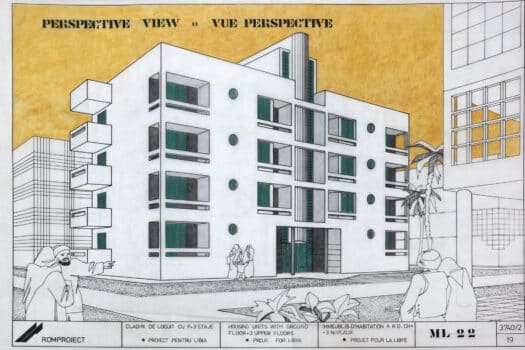
Architecture is the masterly, correct and magnificent play of masses brought together in light. Our eyes are made to see forms in light; light and shade reveal these forms; cubes, cones, spheres, cylinders or pyramids are the great primary forms which light reveals to advantage; the image of these is distinct and tangible within us and without ambiguity. It is for a reason that these are beautiful forms, the most beautiful forms. Everybody is agreed to that, the child, the savage and the metaphysician. It is the very nature of the plastic arts. [3]Le Corbusier’s excellent triangulation of humankind notwithstanding, not everybody is agreed this is the very nature of the plastic arts. I don’t think these core forms are appreciated in the same way in a building as in a sculpture, in part because of the aforementioned evil grain elevator (it is, by the way, the same elevator as in the first photograph). To understand how this grain elevator is evil, it helps to again consider an over-arching question central to these essays: are buildings like sculptures in making landscape? But now I want to consider an artist’s point of view, partly to address the problem noted in concluding the last essay: that Loos's compelling argument, as set out in Architecture, could not clearly account for ongoing evolutions within a landscape.


Here the sculptural response draws all of its cues from its surroundings. ... What is the site’s relation to applied and implied schemes of organization and systems of order, relation, architecture, uses, distances, senses of scale? ... What are the qualities of surface, sound, movement, light, etc.? ... What are the histories of prior and current uses, present desires, etc.? A quiet distillation of all of this — while directly experiencing the site — determines all the facets of the ‘sculptural response’: aesthetic sensibility, levels and kinds of physicality, gesture, dimensions, materials, kinds and level of finish and details, etc., whether the response should be monumental or ephemeral, aggressive or gentle, useful or useless, sculptural, architectural, or simply the planting of a tree, or maybe even doing nothing at all. [9]Imagining examples in this fourth category is difficult. The overriding parameter is the absence of a perceptible intent to frame meaning beyond the realities of the site. It's like repositioning furniture without rearranging it, or perfect plastic surgery. A useful example of what Irwin means can be seen in this roadside car park in Wyoming. Its upwardly bent corner has the same experiential consequence upon approach as the downwardly bent corners of a Giacometti sculpture base: allowing your eye — and inviting your mind — in. But you do not believe the gesture to have been made intentionally. You instead suspect someone backed up his truck too far. Still, it could have been designed this way. There is simply no way to know. So your experience of the physical fact (like that of the unintended geometry of the Igualada Cemetery) is essentially private. There is no legible mandate that connects the gesture to any pattern of space making, or internal history of cultural production. Irwin again: "... the process of recognition and understanding breaks with the convention of abstract referencing of content, historical lineage, oeuvre of the artist, style, etc.” In theory, your entire experience is limited to valuing this one place.